I have moved!
Hi there. I don't live in Berlin anymore as I now live in Wrocław. I am however often in Berlin so if you are interested in a tour perhaps there's the possibility of me being there! Contact me at wroclawworkshops@gmail.com
Otherwise this website shall remain open for articles about history, or for the links to organisations I find to be useful.
regards
Ian
Monday, 6 April 2009


Thursday, 28 February 2008
Sachsenhausen concentration camp themed tours
 'Tower A', the entrance to the camp
The concentration camps of Oranienburg (1933-34) and Sachsenhausen (1936-45) were places where thousands of people died as a result of the inhumane treatment and conditions meted out by the SS. It was a place where prisoners entered through the tower shown above, and for many finished up in what the SS cynically named 'Station Z', the crematorium.
Sachsenhausen concentration camp memorial site exists to inform people of the camp, of it's conditions, prisoner groupings and perpetrators. Many buildings are either still in existence (such as the one above) or have been rebuilt in order to allow people to be educated about one of the darkest moments in human history: the 'Third Reich'.
Sachsenhausen concentration camp memorial site exists to inform people of the camp, of it's conditions, prisoner groupings and perpetrators. Many buildings are either still in existence (such as the one above) or have been rebuilt in order to allow people to be educated about one of the darkest moments in human history: the 'Third Reich'.
 roll-call area
De-humanising of new prisoners
For the Nazis, the people inside concentration camps were not people any more. They were forced to shed their identity after entering through 'Tower A'; taking off their clothes, being shaved from head to foot, being made to wear a uniform, as well as a coloured triangle in order to signify their prisoner category.

red for political prisoners
purple for Jehovah's Witnesses
blue for emigrants
black for 'asocials'
green for criminals
In an average tour through the former concentration camp the guide will tell you about the camp and also details the prisoner categories, including also the Jewish prisoners, who themselves wore the same coloured triangles as above but with a yellow one underneath.
It is indeed very important that one learns about the Jewish prisoners, for reasons of respect but also to warn of modern anti-Semitism (as shown in 1992 when a barrack which contained a Jewish exhibition suffered an arson attack).
Themed tours
A problem with time scales, however, can lead to little or even no time being given to what are often the forgotton concentration camp prisoners: the homosexuals, 'asocials', Roma and Sinti (often falsely known as 'Gypsies') and even the Soviet prisoners of war, 10,000 of whom were executed in the camp.
Therefore, walksthroughberlin offer you tours through the former concentration camp whereby we offer themed tours:
homosexuals
'asocials'
(homeless, unemployed, alcoholics, drug users, wayfarers, among others)
Roma and Sinti
Soviet prisoners of war
'asocials'
(homeless, unemployed, alcoholics, drug users, wayfarers, among others)
Roma and Sinti
Soviet prisoners of war
These tours are like ones you would usually receive in the memorial site, with a covering of:
the first camp in Oranienburg
the political prisoners
reasons for building the Sachsenhausen camp
induction of new prisoners
different groups of prisoners
conditions in the barracks
Jewish prisoners
the camp prison
shoe-testing track
roll-call area
infirmary
medical experiments
morgue
gas chamber
crematorium
history of memorial site
Our tours go beyond the normal tour however in concentrating about the victim group of your choice, using biographies and visiting areas. We find that the personal approach is a much better means of discovering the history of the place, and therefore value greatly the chance to talk about people who do not usually get remembered.
We are experienced guides, trained by the memorial site who have done tours through the Sachsenhausen concentration camp memorial site, who also do tours in other places connected with the Nazi years of terror and murder.
An additional bonus of booking a tour with us is that you will not be part of a big group. You shall be alone, or in groups of less than five, and therefore the tour can be much more personal and we are more free to tailor the tour to your individual needs.
Prices
The price for the themed tours are 15 Euros each. People who also wish to visit the Klinkwerk memorial site, a place close to Sachsenhausen where homosexuals were killed through work pay 4 Euros extra.
Additionally, we can also show you the many SS houses and camp buildings that are still in existence close to the camp. For this special unit which includes an analysis of the SS (an ideological organisation of terror that led to the death of millions); a history of Theodor Eicke, the Inspector for the concentration camps and a look at where he lived and worked, we charge an additional 4 Euros.
Book a themed tour by Emailing
walksthroughberlin@googlemail.com
Tuesday, 26 February 2008
'Euthanasia' in Berlin

Wittenau Sanotorium, in the north of Berlin in a place now known as the Karl-Bonhoeffer-psychiatric unit, was a place which served as part of the Nazi 'Euthanasia' system. Thousands of patients were either killed there or were sent from there to be killed in other places.
In 1880 the 'lunatic and idiot institution' was built specifically for 'calm and agitated lunatics, agitated and unclean sick people, epileptic lunatics and bodily afflicted lunatics', together with a separate unit for 'idiotic children'. The start of the 20th century brought with it the foundation of an 'abstinence sanatorium' for alcoholics, morphine and and cocaine addicts, together with a welfare unit for mentally ill people.
As the 1920's arrived research was carried out into the patients in the units with regards to hereditary diseases, a research that was influenced by a social darwinism theory of 'racial hygiene' that would later be influential upon events after 1933.
The theory of 'racial hygiene' in Nazi Germany held that 'inferior' and 'burdening' people were producing a race of 'idiots', and that, coupled with their perceived higher birth rate, was seen as being bad for the German nation. 'Inferior people', so it was said, should be 'cut out' from society. Such a view led to the setting up of the 'law for the prevention of hereditary pro-creation', which led to the forced sterilisation of around 360,000 people between 1933 and 1945, which also happened in Wittenau.
The theory of 'racial hygiene' in Nazi Germany held that 'inferior' and 'burdening' people were producing a race of 'idiots', and that, coupled with their perceived higher birth rate, was seen as being bad for the German nation. 'Inferior people', so it was said, should be 'cut out' from society. Such a view led to the setting up of the 'law for the prevention of hereditary pro-creation', which led to the forced sterilisation of around 360,000 people between 1933 and 1945, which also happened in Wittenau.

The start of WWII brought a further development. Many old doctors from the unit joined the newly formed 'office for the extermination of those unworthy of life' on Tiergartenstraße 4, the so-named 'T4 action' (click on 'Berlin remembers victims of Nazi 'euthanasia' on the right for more details).
This legalised the 'mercy killing' of disabled, mentally ill and handicapped people. Around 200,000 were killed in total. Wittenau was part of this:
This legalised the 'mercy killing' of disabled, mentally ill and handicapped people. Around 200,000 were killed in total. Wittenau was part of this:
Wittenau served as an 'inbetween unit', which meant that those selected by other units to be killed were sent to Wittenau before being sent to other places, where they would be killed. It was done in this way to try to hide the purpose of their transporting. Around 3,000 Wittenau patients were killed in other places in this way.
Killing also took place in Wittenau itself. 4,941 people were killed through oral tablets or through hunger. Furthermore, around 5,000 children born with hereditary children were brought to Wittenau in order to receive a 'mercy killing'. Some were used for medical experiments.
Killing also took place in Wittenau itself. 4,941 people were killed through oral tablets or through hunger. Furthermore, around 5,000 children born with hereditary children were brought to Wittenau in order to receive a 'mercy killing'. Some were used for medical experiments.
As I said on the post about the persecution of the 'asocials' (click on 'persecution of 'asocials' remembered in Berlin' on the right for more details) it took decades before research was done into what forgotten themes. Eventually in the 1980's employees of the Karl-Bonhoeffer-sanatorium did their own research which led to the publication of the book 'Totgeschwiegen: 1933-1934 zur Geschichte der Wittenauer Heilstätten seit 1957 Karl-Bonhoeffer-Nervenklinik' and an exhibition is now to be seen there.
UPDATE: The exhibition has been redone and there's an internet site for it (in German): http://www.totgeschwiegen.info/index.html
Directions can be found on the site. It's easy to get there by S-Bahn or U-Bahn and then a short walk.
UPDATE: The exhibition has been redone and there's an internet site for it (in German): http://www.totgeschwiegen.info/index.html
Directions can be found on the site. It's easy to get there by S-Bahn or U-Bahn and then a short walk.

Thursday, 14 February 2008
'East/West - sex and politics' film review

At the moment here in Berlin the 58th Berlinale Film Festival is taking place. The other night my girlfriend and I dashed to Potsdamer Platz to see what film we could see. We bought tickets for the above mentioned film, without knowing what it was. This turned out to be a very good idea.
'East/West - sex and politics', a film by Jochen Hick, is about gay and lesbian communities in Moscow, and their struggle in a city where its mayor, Yuri Lushkov, views them as being 'satanic', and has banned their gay pride marches in Moscow in 2006 and 2007.
The film starts off with scenes from 2006, where an illegal march took place. This march was met by counter-demonstrators, including Neo-Nazis and members and Priests of the Russian Orthodox Church.
The film goes on to show the attempts to have a march in 2007 recognised by the Moscow state. People like Peter Tatchell, the German MP Volker Beck and other LGBT activists from across the world came to support them. First they convened in a city hall for a conference, in a hall surrounded by police to 'protect' those outside from those inside, before attempting to do a march outside.
The photos at the top of this page. The one on the bottom right shows Peter Tatchell, the British gay rights campaigner, just after he was punched by a counter-demonstrator. The police did nothing to pursue his attacker, rather, they arrested Tatchell himself, as well as the gay pride organiser Nikolai Alexeyev. Click on 'East/West - sex and politics' film review' above to see a film clip of the march.
The film goes on to show gay and lesbian life in Moscow, showing that many small communities live. These communities are very vital, however. One woman who was at the march was seen on TV and was sacked from her job the next day.
As it is, the gays and lesbians in Moscow do have their own scene, and bars and clubs to go to. Moscow is the city in Russia where they go to, apart from St. Petersburg. Homosexuality is a hidden issue in Russia and the film shows many people who moved to Moscow to be more open about their sexuality. For men from places like Armenia, Moscow gives them a chance to meet other gay men. As it is, men and women from the Caucus region face a stigmitisation anyway.
The film also shows well the debates between the homosexual communities. Some are against the gay pride marches, seeing them as being antagonistic to the Muscovite society and doing more harm than good. A gay man is quoted as saying that Russians are, by nature, people who are more tolerant and open behind closed doors.
This is something similar to what I heard in another film, 'Rainbow's End' where anti-gays in Kraków, Poland were saying that they don't mind what people do behind closed doors, it's the openness that they hate. I know from here in Berlin that the Westberlin Aktiongruppe decided, after 1969, that gays and lesbians should be able to have a free life, not hidden behind closed doors. Whether this is applicable in Moscow is a debated point.
As it is, I very much recommend this film. It shows the extreme pressure that gays and lesbians suffer in Moscow, but also shows their willingness to fight, together with support from people from other countries.
I cannot pass without commenting on the Russian Orthodox Church. There were extremely shameful scenes, where those who were physically attacking those on the gay pride were being blessed by a Priest who attended the protest. Indeed, this same Priest stirred up the crowd with the chant 'Moscow is no Sodom', which shows his lack of knowledge of what Sodom means. I am not being a liberal Christian in saying that, I am being biblical: 'Behold, this was the iniquity of your sister Sodom: pride, fullness of bread, and careless ease was in her and in her daughters; neither did she strengthen the hand of the poor and needy.' Ezekiel 16:49!
So maybe Moscow is Sodom then. Now, I have a lot of respect for the Russian Orthodox Church, I attend their services in Berlin and have used their prayers for years. However, their treatment of homosexuals is an abomination. When Christians are allied with Neo-Nazis, then it is deffo not the case that ubi caritas et amor, deus ibi est (where there is love and charity God is present).
There was however an exception in the film. An Orthodox Priest took it upon himself to do a ministry to the gay and lesbian communities. He said that it is a shame that no-one ministers to them, rather, they exclude them. He visits their homes and listens to them, and prays with them. He criticised the Russian Orthodox Church by saying that it has got too involved with politics. He said that they seek power, which is against the Christian gospel.
He is a holy man. As is Peter Tatchell. He is somewhat infamous in Anglican circles for his demonstrations in Anglican services, but as far as I am concerned, the man is a Saint, due to his striving for justice and willingness to suffer violence for that cause.
I found the film very upsetting and also very moving. You may wonder what my own personal connection to homosexuals is? Well I have no real reason, really. I simply see that they suffer a lot of persecution, and, shamefully enough, from my own (Anglican) Church. I see that they suffered during the Nazi times, and were a forgotten group afterwards. Therefore I do the tours in the gay museum in Berlin:
http://walksthroughberlin.blogspot.com/2008_02_05_archive.html
and am about to do tours in other areas that remember the forgotten victims of Nazi persecution, which is another reason why I started this website.
Please, recommend this film to your friends. See it at Berlinale if you live in Berlin. Tell others about it.
Oh, and, Nikolai, if you are reading this, I was the man who asked the last question after the film, about homosexuals in other places in Russia. :)
Friday, 8 February 2008
more walks I have done in Berlin, and also by the Baltic sea
 me with dog in former death strip

 not a walk as such, rather me in my flat
 that place by the Baltic sea we went to

Tuesday, 5 February 2008
tours in Gay Museum in Berlin
This museum is very interesting is is worth a visit for anyone visiting or living in Berlin.
__________________________________________________________________


Now, it's possible that you can receive a tour from myself in this museum as I am often in Berlin. If you wish to receive a tour there send an Email to walksthrougberlin@googlemail.com
__________________________________________________________________
Self-awareness and persistence —
200 years of Gay History
200 years of Gay History
Permanent exhibition at the Gay/Schwules Museum
Celebrity postcard of the female impersonator Bobby Waldon, Berlin c. 1900, Berlin, Sternweiler Collection
On December 6, 2004 the Schwules Museum opened its new, permanent exhibition. The display occupies the entire first floor, long-term rental of which has been secured with the generous bequest of Prof. Dr. Christian Adolf Isermeyer. Preparations and actual installation were realized with the financial support of the Stiftung Deutsche Klassenlotterie Berlin. Now, after years of regularly changing displays, we can also present a permanently installed overview of gay history in Germany, with a special focus on Berlin.
Nineteen years ago the museum first opened its doors. A permanent exhibition was envisioned from the start and thus research was carried on throughout and a vast collection built up. Our new display covers nearly two centuries of social change with many highs and lows between 1800 and 1970. The historic foundations of contemporary gay pride and self-understanding will be revealed by tracing the gradual process of European Enlightenment that enabled minorities or those who thought and acted differently, to define their own lives.
The narrative perspective is that of homosexuals themselves. Various possibilities of shaping of one's own life are explored in the face of ongoing oppression, persecution and punishment. Instances of self-awareness and perseverance are highlighted. Without these qualities it would have been impossible to fulfill ideals and desires. Without them it would not have been possible to resist social pressure and find a partner or likeminded friends, to create circles and networks. How did such self-confidence come about, what kind of support was needed? This is the central question which the exhibition addresses in different contexts. The love stories among the gods and heroes of Antiquity, which especially since the Renaissance were omnipresent in Europe, challenged producers of art and literature to find new forms of expression over and over again. Episodes from the Bible, such as the account of David and Jonathan or Jesus and his favorite disciple John, could be read as examples of close friendship and even love among men. Oral traditions and academic research led to listings of famous homosexuals who inspired individuals to shape their own love life and served as a life aid for private happiness despite public scorn.
Peter Martin Lampel, welfare service pupils, friends, around 1929, oil on canvas, Berlin, Sternweiler Collection
Studio Eberth, William Bendow as "magnesia. The Tetovirte lady", around 1930, photography, Berlin, Schwules Museum
Erotic desire and the longing for male nudity found fulfillment through all kinds of impulses. Reproductions of such images held in art collections and museums might be installed at home. From the early 19th century onwards there was a wide range of public displays with sparsely dressed or nude males who, initially modeling themselves on ancient times, engaged in swimming and other sports; increasingly, acrobats and other strongmen performed on the stage. This is a theme of its own and examples will be shown for different epochs. Earlier myths of a gay paradise stemmed from depictions of an alleged ideal world during Antiquity; from 1840 on, after discovering the blue grotto, the Isle of Capri was a centre of gay men's attraction. The exhibition includes Ferdinand Flor's painting of bathers in this very setting, as well as early photographs by Wilhelm von Gloeden. Around 1900 a rather liberal cult around nudity arose in Germany, which eventually also contributed to the fact that in the Weimar Republic era Berlin became a new 'isle of the fortunate'. In the 1950s and 60s the Californian beaches with their musclemen represented the next mythical wave of 'paradise regayned'.
Private identity searches were often carried on with the help of novels and poems, the precondition being a selective and imaginative reading mode. Academic works, even legal and medical documents have served as a support for individual action. Publications such as Psychopathia sexualis by Krafft-Ebing (1886) or by predecessors like Ludwig Casper and Karl Westphal in Berlin could, regardless of prejudiced views and negative case studies, be seen in a positive light. Individual self-awareness and sheer perseverance were always a precondition for the establishment of gay friendship circles, networks and subcultures which can be traced back to 1700 in many European cities. In Paris, London, Amsterdam, Rome, Naples, Vienna and Berlin such circles had their own meeting spots, private entertainment, fashion styles and jargon. Despite ongoing oppression throughout the 19th century, an extensive gay subculture was able to establish itself in Berlin.
The transformation from individual networks into politically motivated organisations took about 50 years, as shown by the example of men like Heinrich Hössli and Karl Heinrich Ulrich through to the foundation of the Scientific-humanitarian Committee by the Berlin physician, Magnus Hirschfeld in 1897. It was the starting point for a veritable campaign of public consciousness-raising with essays, books and legal proposals. They were particularly aimed at the organs of oppression that had been operating over hundreds of years, the police, politics, parliament, the law, churches, the medical and legal professions, writers and so on. By 1900 the search for coalition partners at all social levels was showing fruit. Our display pays due attention to the zenith of this development, represented by Berlin in the 1920s. In the years of the Weimar Republic gay men and women ran so-called Friendship associations with a membership of up to 40.000.
Biographical and documentary exhibits on groups and individuals clearly show how the challenge of defining one's own life while simultaneously partaking in contemporary culture and politics was successfully taken on. With his Institute of Sexual Science, set up in 1919, Magnus Hirschfeld fought not only for the equality of homosexuals but also for all-round sexual education, including birth control. Peter Martin Lampel exposed malconditions in reform schools.
His interviews with youths from boys' homes led to a series of books, theatre plays and films that actually brought about some change. Gallery owners such as Alfred Flechtheim and Fritz Gurlitt confronted censorship and prudery by publishing erotic art series with gay and lesbian themes. Max Terpis, Harald Kreutzberg and Anita Berber made significant contributions to the development of modern dance. Through the cabaret performances of Wilhelm Bendow and Hans Deppe drag and camp gained further social acceptance, the ground for which was prepared by female impersonators who had been entertaining the masses in variety shows since the 1890s. Lesbian women and gay men were visible and audible at many social levels, be it in youth associations or the teachers reform movement, in literature, film and theatre. During this period the main aims of European Enlightenment seemed to be realized in Berlin, not only for gays and lesbians. However, 1933 brought the turning point that led to the full catastropy, a development which had of course manifested itself earlier with other reactionary forces and coalitions.
Solidarity, lithograph by Richard Grune, Kiel 1945, Berlin, Schwules Museum
The thorough destruction of lesbian and gay organisations and activities resulted in the renewed isolation of homosexuals. The contempt fostered by the Nazis for each and everyone who thought or acted differently, deployed traditional prejudices found within society itself, the churches and the medical profession, and soon posed a real threat to homosexual lives. The terror incited by the state graduated from tightening the laws on male homosexuality to increasing jail sentences, from there to so-called protective custody in penitentiaries and concentration camps. Between 1940 and 1942 explicit murder campaigns were staged particularly in the quarries of Sachsenhausen, Mauthausen, Flossenbürg and Natzweiler. Each step being aimed at annihilating individual and collective self-esteem, the summary effect lasted way beyond the year 1945. Nevertheless, there have been examples to the contrary even during the Nazi era. Our display includes stories of gay pride and perseverance, of opposition and conformity, of solidarity and individual courage both in Germany and in exile.
The destructive force of Nazi rule lingered on through the early years of the German federal republic, as shown by the rather timid attempts to regain previously known areas of freedom. In the 1950s, during the reactionary Adenauer era which was dominated by fundamental christian ethics, these attempts were repeatedly suppressed. Only in the 1960s with a new generation setting out to change the world as they knew it, Germany too underwent significant changes comparable to earlier reform impulses around the turn of the century. The so-called flower power movement included gays and lesbians and led to a new self-confidence. From 1970 onwards a fighting spirit developed which to this day effects a wide spread of lesbian, gay and trans-gender lifestyles.
Poster for the 2nd ICSE Congress in Frankfurt - on - Main, 1952, Berlin, Schwules Museum, continuous loan
The permanent exhibition has been designed as an 'open system' with many aspects and angles. Together with exhibition architect Rainer Lendl a structure was developed that allows for regular changes and additions. Exhibits and display groupings are purposely arranged so as to avoid the impression that this is the final or solely valid view on historical developments. Within each thematic set it will, rather, remain clear that the objects are merely remnants and more or less haphazard findings. They represent the unearthing of a multi-layered history, the overall arrangement being modeled on constructivist paintings. Delicate original works on paper, highly sensitive to light, are to be exchanged every six months. Visitors will thus be able to discover new insights and impulses. The larger walls are reserved for works of art from several epochs. Our vast collection ensures that these, too, can be exchanged at regular intervals. Apart from updating the presentation, it is thus possible to shift the emphasis and shed yet another light on specific moments within the history of homosexuality. Smaller displays addressing a special issue can also easily be incorporated in the permanent exhibition. The period between 1900 and 1970 includes several personal biographies, a mainstay of the work done at the Schwules Museum. Here again, material from the museum's own collection can be exchanged to provide further details to the overall view.
Don Whitman, Friendship, 1950s, photography, Berlin, Sternweiler Collection
Text and photos copied with permission from the Gay Museum website, www.schwulesmuseum.de
___________________________________________________________________
___________________________________________________________________
Now, it's possible that you can receive a tour from myself in this museum as I am often in Berlin. If you wish to receive a tour there send an Email to walksthrougberlin@googlemail.com
Friday, 1 February 2008
a walk I did in Berlin
One day my girlfriend and I went along a 'Jewish' walk along places where Jewish places to be exist in Kreuzberg. Part of the way is the path of the former Berlin wall, marked by bricks on the ground. We saw some interesting buildings along the way, and even saw some of the former death strip.
 Jewish Museum, Kreuzberg
 my girlfriend in front of the old death strip, with the former East Berlin behind her
 the former death strip again, not yet redeveloped, obscured by advertising
note the communist architecture, which you won't really see if you go to the touristy areas
 just across the road on the west side, a paper factory
 looking back east at the former death strip
Thursday, 31 January 2008
Nazi persecution of 'asocials' remembered in Berlin

the black triangle 'asocials' were made to wear in concentration camps
This year the 'Haus der Demokratie und Menschenrechte' here in Berlin has been/are putting on events to do with the persecution of so-called 'asocials'.
Background
The planned murder of the European Jews and the disabled, mentally handicapped and mentally ill can be see, according to Holocaust researcher Christopher Browning, as being one of two parts of the Nazi crusade, the other being the persecution of the so-called 'Gypsies' (Roma and Sinti, in fact) and the 'Asocials', both of whom were seen as 'inferior' beings in the pseudo-scientific view of the Nazis. The crusade as a whole was to have extermination as its key goal.
On January 26th 1938 Heinrich Himmler, Reichsführer of the SS and by then also Chief of the German Police proclaimed the 'action work-shy Reich'. A later directive to come out of the Reich Criminal Police department on Wilhelmstrasse was to define 'asocial' as meaning those who 'demonstrate behaviour contrary to society (which does not just mean criminal behaviour) which shows that they do not wish to fit into society'. This would mean the arrest of beggars, vagabonds ('Gypsies'), wanton people, alcoholics, the chronically ill, people with sexually transmitted diseases, the imprisoned, people who leave their work 'without good reason' (which included those who went on strike), the 'work-shy' and the unemployed. Over 12,000 were arrested in 1938 by the mostly by the criminal police assisted by the Gestapo, and were put in concentration camps.
Dr. Wolfgang Ayass gave us a lecture in which I asked him why it was that it was the criminal police that arrested them. I would have imagined that the order police (general bobbies) would do it. His answer was that the criminal police were the leading movers of their arrest as their behaviour was labelled as criminal, and also that it was a pre-emptive arrest, in case they do something criminal.
The conditions for the 'asocials' in the concentration camps were worse, in comparison to the 'political' prisoners, in terms of the living and work conditions and treatment meted out to them by the SS guards. Sadly, it was also the case that they suffered prejudice from other prisoners and were therefore less likely to receive help from them. All in all, the death rates of 'asocials' (the 'blacks', owing to their triangle colour) were higher than that of the 'politicals' (the 'reds', likewise) due to what was in effect a policy of extermination. This policy however cannot be compared to the policy of exterminating the Jews, not just to the massive difference in numbers, but also as 'asocials' were dying through work ('Vernichtung durch Arbeit' and conditions, not through mass executions and gas chambers.
In comparison to other victim groups we have little information about how many 'asocials' were arrested and how many died. In total it is estimated that over 20,000 'asocials' were put into concentration camps and 'work-houses' and of those an estimated 10,000 died.
After 1945
Dr. Sven Korzilius imformed us at another lecture of the persecution of what the German Democratic Government (GRD, otherwise known as East Germany) termed as 'asocial' and 'parasites'. Thousands faced arrest as from 1948 in the Soviet sector and, over the years that were to come, the same people persecuted by the Nazis were being targeted by the Communists. As some fellow listeners were very quick to point out however, it was not the same as what the Nazis were doing as the Communists did not have a policy of extermination.
As it was, it would not be until the 1980's before 'asocials' were recognised as a victim group by governmental authorities, academics and the public. The reason was as follows:
groups like 'asocials, criminals and homosexuals were still classified as being criminal after the war, and after their liberation from concentration camps. Many were put back into prisons. This led to a lack of sympathy for them, which was not the case with other groups (though even with then it took decades).
It was only through the efforts, not of an international campaign, not of a TV programme or film, not of a governmental institution, but of care workers themselves working with such people. Homeless and alcoholic care organisations began to do research of their own accord to relate their work to the Nazi past. It was the same with psychiatric care units and carers for the disabled and mentally handicapped. It is only through them that we are able to know about this past now.
This is also shown through access to survivors of this time. Now of course there are a lot less of them in comparison to Jewish survivors, but is also the case that shame was attached to their stays in concentration camps, or even their labelling as being 'asocial'. There are very few biographies written of them, and the ones that I do know about are written by those whose reasons for being homeless or being a wayfarer was that they were mentally ill.
This is also why, even now, that little information is known about the 'greens', the criminals in the concentration camps. Now, many 'reds' are not sympathetic to them as they were often made to be 'Kapos' (prisoners in charge of other prisoners) and many stories exist of them being brutal and murdering prisoners, but it is my view that it would be good to know more about them. 'Asocials' and homosexuals are now not regarded as being criminal. Criminals, however, are. (yes, I am aware that the person is more than their criminality, but I am using the concentration camp definitions here).
East German defensiveness
As I said, some people were quick to point out that the GDR regime did not do what the Nazis did. In my view former GDR people are very sensitive to criticisms of what was done in their country, especially when the people doing the criticism are old members of the Federal Republic of Germany (West Germany). I did learn though that the emphasis given to work in the socialist system meant that those not working were persecuted. Indeed, as a friend of mine says, they were put into prison. An influence here is Stalinism, which included the persecution of the 'enemy within'.
In looking at the GDR persecution of 'asocials' deeper, however, we have to look beyond the Nazis:
Influences on the Nazis
The pseudo-scientific view of the Nazis drew its ideology from Darwin and Henry Goddard's view of 'Eugenics', a view that traits such as alcoholism, criminality, being 'work-shy' and so on were genetic. This led to the later policy of extermination.
However, it has to be said that some of the key people speaking out for the arrest of the 'asocials' and putting them to work (what the Nazis later used as 'Arbeit macht frei') were carers for the homeless themselves. In the 1920's such views were being expressed, and a number of feminists were saying that certain groups of people should be forcibly arrested. I would speculate that this was how a general acceptance of their later arrest by the Nazis would make this possible. In fact the phrase 'by the Nazis' is not totally true, in that not everyone in the criminal police were Nazis.
Conclusion
My point is that the persecution of the 'asocials' is not limited to the Nazis, it was done by the Communist regime in the GDR and had its roots in pre-Nazi Germany. Exclusion of such people is not limited to the past, as we see it in our own countries.
Some of the people who were at the talks are care workers for the homeless and alcoholics themselves. They spoke of the problem that unites all persecution is seeing them as objects, not as subjects. It is not naive to express that the view that 'they' have their own histories and reasons for what is labeled as 'asocial' behaviour. I trust care workers in helping them. My experience from GB is that the work of caring for such people is a holistic, life-long work.
That's enough preaching, though. Just one thing to add: normally the events I go to about the Nazi past are attended by people in smart clothing, educated people, academics and people who I would call middle class. The people in the 'Asocial' events I go to are working class, unemployed, mentally ill, and care workers. That the two don't come together says something, to me.
Thank you for reading to the end of this report! :) If you have any comments post them underneath.
Sunday, 27 January 2008
Olga Benario

Olga Bernario (1908-42)
Olga Bernario (ne Prestes) was from Munich and was born into a Jewish family. At the age of 15 she joined the Communist Youth Organisation. She later moved to Berlin, to Neu-Kölln and had a relationship with Otto Braun, also a communist. He was arrested by the political police in 1928 and, when visiting him in a prison in Berlin, she successfully freed him along with other communists. They were both put on the wanted list and they fled to Moscow, where Olga underwent military training. She moved back to Germany and acted as a spy, also doing work for the communist party in Argentina, Great Britain and Brazil, where she immigrated in 1934.
She was part of a group that was to organise the revolution that happend in 1935. The government suppressed the revolution severely, leading to the death of over a hundred revolutionaries and many leaders of the revolution were arrested, some of whom were executed or died due to torture.
Meanwhile, she had got into a relationship with Luis Prestes and she became pregnant. The Brazilian government decided to extradite her to Germany in 1937. An international protest took place to try to save her, but it proved unsuccessful. As she was wanted in Germany, she was put in prison straightaway. She was in a cell which had no window and it was in that surroundings that she gave birth. She called the baby Anita and cared for her in that same cell, before one day her baby was taken from her and eventually made its way to Brazil, where she was cared for by the mother of Luis Prestes, before being looked after by the father, Luis, upon his release.
Olga however was sent to the womens concentration camp in Ravensbrück and developed good contacts with her fellow prisoners. One day however she was selected to be executed and was killed in the gas chamber there.
I learned all this as I went to watch a film about Olga last Thursday in the 'Olga Bernario Exhibition' in Neu-Kölln. You can watch a short trailer to film about her if you click on the title above. While it is in Portuguese, it is worth watching for the pictures. It is not the film that I saw. The one I saw was more restrained.

Holocaust memorial day 2008

arrival and selection of Hungarian Jews, Birkenau, 1944
My prayers are with the many people who are recognising today, through commemorations, services, or simply in their private lives.
'if history has something to teach us, then it is not the continued institution of new memorials, remembrance days and museums that enable the public to calm its conscience, rather, it is the taking up of the 'never again' in our current setting of injustice and genocide.' Phillip Blom
What do you think is meant by the words 'taking up of the 'never again''? Please give your opinions underneath.
Saturday, 26 January 2008
Commemoration of victims of Nazi 'Euthanasia'
 the 'grey bus' memorial
by Horst Hoheisel und Andreas Knit
Last Friday I went to a commemoration of the victims of the Nazi 'Euthanasia' programme. Between 1933 and 1945 around 200,000 physically disabled, mentally handicapped, mentally ill and old people were killed through injections, tablets, shooting, lack of care and gassing. The latter medium of death was in six different places in Germany and Austria which alone were responsible for over 70,000 deaths between 1939 and 1941, in gas chambers that served as testing stations for the gas chambers that would later be set up to kill Jews, Roma and Sinti.
Since visiting the memorial site for one of those killing stations in Hartheim, just north of Linz in Austria when I was a volunteer in Dachau, I have taken a great interest in this area. This has been renewed since moving to Berlin and visiting the clinic in Wittenau in the north of Berlin, which was used as a transit point for people about to be sent off to be killed elsewhere, as well as being a place where sterilisation took place and also the killing through tablets of mentally ill people.
The 'T4' office, which refers to the address where it was (Tiergartenstraße 4) , where the above memorial was put. Now the Berlin Philharmonic building is to be found there. That is where a function was given to go along with the placing of the 'grey bus' in its place. Grey buses were, you see, used to transport those destined to be killed. The words 'where are you taking us' are inscribed within the memorial.
I have been to many such functions now and am not the biggest fan of them, but the speeches given were very good. Normally speeches by public officials are kind of political propaganda, but ones from Baden-Württemburg were impassioned, informing us of what happened in the killing centre in Grafenek. Another speech I liked was given by the vice-president of the German parliament, who is SDP, who spoke of the fact that all victim groups need to be commemorated, and that slowly this is happening.
As I was listening to all this, however, I was thinking that the speeches being given were done from the side of those in authority. As good as those speeches were, the side of the victims were missing. Various institutions that work with the psychically disabled and mentally ill were part of the body that organised the placing of the 'grey bus' in Berlin, but no-one from them were given a speech.
It did happen though. Sigrid Falkenstein, a woman in her 50's, spoke of Anna Lehnkering, who was her auntie. Anna was someone of a 'simple disposition' who, in 1936 when she was 24 years old, was forced into a clinic in the Rheinland. A doctor had previously investigated her and labelled her as a 'burden'. Four days after her arrival in the clinic she was sent to Grafenik, and died within the same day she arrived. The official cause of death was 'peritonitis'. Actually, she had been gassed.
Her death was not spoken about in the family for decades. Sigrid had two older brothers who remembered her, and simply spoke of the shame they felt for having such a sister, who would today probably be called someone with 'learning difficulties'. Other than that, no-one spoke about her, and about her death. Then one day Sigrid was on the internet looking into the victims of the 'Euthanasia' programme and she came across her aunty's name. That is how she learned how she died. Sigrid got involved with various bodies campaigning for more recognition in Germany, and was part of the group who installed the 'grey bus' in Berlin.
For me, this story shows something quite typical in Germany: many absences have been repressed and it took decades before people spoke of them. Eventually a memorial site to the victims of the 'Euthanasia' programme will be built in Tiergartenstraße 4. Otherwise a memorial site to the victims of 'Euthanasia' is in Wittenau, a place where I did a tour for Action Reconciliation Service for Peace last year. If you want more information then let me know.
Friday, 25 January 2008
Berlin: the 'presence of absence'
Berlin is a place I love. At first I wasn't that too impressed with the place. I preferred Munich, a city with more beautiful architecture and parks. I still believe that, but after some time I discovered that Berlin has very beautiful places.
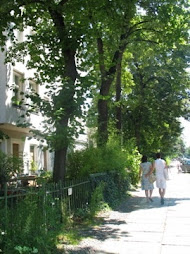
Look at the Landwehrkanal photo on the right. The picture shows me and my girlfriend walking on our way to get a all you can eat Sunday buffet. Walking along the Landwehrkanal once sees many interesting places, such as a place where a synagogue used to exist, before being destroyed by the Nazis.
That's the thing about Berlin, beauty alongside scars of the past. Berlin has places full of what Micha Ullman called the 'presence of absence', places where things used to be, that no longer are. People who used to live there, whose lives were taken away. How does one commemorate this absence?
I used to do tours in the Sachsenhausen concentration camp memorial site, where some group members would criticise the communist memorials there. Once, while doing a tour in the middle of a grassy area, I stopped talking and listened to the silence, as the wind rustled through the weeds. That, the nothingness, seemed a better form of commemoration. That is why Ullman used a empty library to show the place where around 20,000 books were burned by the Nazis, in Bebelplatz.
Nothingness, emptiness, silence. One find that in many places in Berlin. Even when new buildings have been made there or when it lays on a busy street, an absence is there, an absence that speaks of what used to be and what no longer is.
Sometime this absence has been commemorated through memorials, memorial sites, plaques, 'stumbling stones' and museums. People come to Berlin to search for these places where such presences commemorate such absences. Or people go to events where such absences are spoken of.
That is why I moved to Berlin, and is why I have started this site. Will you walk through Berlin with me, as I show you what I see, and speak of what was? I hope so. Write your comments underneath. :)
Subscribe to:
Posts (Atom)